
Commercial Truck Accident Claims: Federal Motor Carrier Rules
Injured by a semi truck? Learn how commercial truck accident claim federal motor carrier rules build your case. Call (855)-545-2917 for a free review.

By Orion Hale
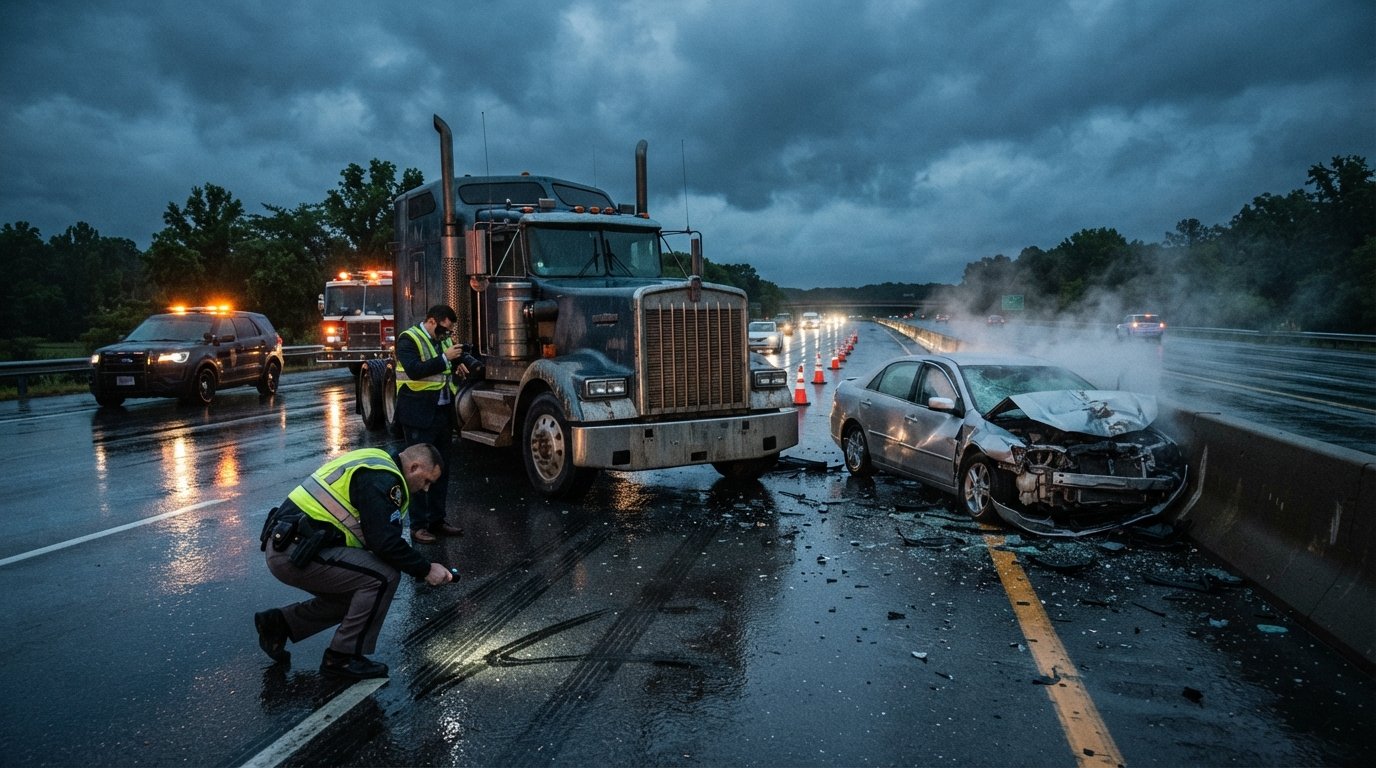
A fully loaded semi truck can weigh 80,000 pounds, roughly 20 times the weight of the average passenger car. When that much mass collides with a smaller vehicle, the consequences are catastrophic: spinal cord injuries, traumatic brain injuries, amputations, and wrongful death. If you or someone you love was hurt in a crash with a commercial vehicle, the path to recovery is not the same as an ordinary car accident claim. A commercial truck accident claim federal motor carrier rules shape nearly every aspect of the case, from which evidence must be preserved to who can be held liable for your injuries.
Federal regulations govern how trucking companies hire drivers, how long those drivers may stay behind the wheel, how often trucks must be inspected, and how crash data must be recorded. These rules exist because trucking crashes are so destructive. When a carrier violates them, that violation can become powerful evidence of negligence in your claim. Understanding the regulatory framework is the first step toward holding the right parties accountable and maximizing your recovery.
Federal Motor Carrier Safety Regulations: The Rulebook Behind Your Claim
The Federal Motor Carrier Safety Administration (FMCSA) writes and enforces the Federal Motor Carrier Safety Regulations (FMCSRs), a sprawling set of rules that apply to commercial motor vehicles operating in interstate commerce. A commercial motor vehicle generally includes any vehicle with a gross vehicle weight rating of 10,001 pounds or more, any vehicle designed to carry 16 or more passengers, or any vehicle used to transport hazardous materials. Most tractor trailers, box trucks, and large delivery vehicles fall under this definition.
These rules are not abstract. They create concrete standards of care that a trucking company and its driver must meet. If a carrier skips a required inspection, pushes a driver past the legal driving limit, or fails to verify a driver's qualifications, those failures can be introduced as evidence that the company breached its duty of care. In many states, a violation of an FMCSR is treated as negligence per se, meaning the injured person does not have to prove that the conduct was unreasonable, only that the rule was broken and the crash resulted.
The most consequential rules for crash victims fall into three broad buckets: hours of service, vehicle maintenance, and driver qualification. Each one leaves a paper trail that a skilled attorney can obtain through discovery or a spoliation letter sent soon after the crash. Because trucking companies are sophisticated corporate defendants with legal departments and insurers on retainer, the evidence battle often begins within hours of the collision.
Hours of Service and Driver Fatigue: The Leading Cause of Truck Crashes
Driver fatigue is one of the most common contributing factors in serious truck accidents. The FMCSA hours-of-service (HOS) rules limit how long a driver may operate a commercial vehicle before taking a break or going off duty. For property-carrying drivers, the core limits include a maximum of 11 hours of driving after 10 consecutive hours off duty, a 14-hour on-duty window, and a requirement to take a 30-minute break after 8 cumulative hours of driving. Drivers may not exceed 60 hours on duty in 7 consecutive days or 70 hours in 8 consecutive days without a reset.
When a truck driver falls asleep at the wheel or suffers fatigue-related lapses in attention, the resulting crash is rarely a simple accident. It is often the product of a company culture that incentivizes speed over safety, schedules that leave no room for rest, or dispatchers who pressure drivers to falsify logs. An attorney can request the driver's logs, dispatch records, and payroll data to reconstruct the driver's actual schedule in the days and weeks before the crash.
Common HOS violations that surface in litigation include:
- Driving beyond the 11-hour limit or the 14-hour on-duty window
- Failing to take the required 30-minute break
- Falsifying paper logs or editing electronic logs to hide violations
- Working for multiple carriers in a way that evades cumulative duty limits
- Coercing a driver to violate HOS rules under threat of termination or pay cuts
Each of these violations supports a negligence claim and, in some cases, a claim for punitive damages if the carrier's conduct was especially reckless. The FMCSA also prohibits carriers from coercing drivers to violate the rules, and drivers who report coercion are protected from retaliation. That protection matters because it gives insiders a reason to come forward with information that helps injured victims.
Electronic Logging Devices, Black Box Data, and the Digital Evidence Trail
Since 2017, most commercial trucks have been required to use electronic logging devices (ELDs) that automatically record driving time, engine hours, vehicle movement, and location. ELDs replaced paper logs in large part because paper logs were easy to falsify. The data from an ELD is far more reliable and far more revealing: it can show exactly when a truck moved, how fast it was going, and whether the driver had exceeded legal limits.
Beyond the ELD, many trucks carry event data recorders (often called black boxes) that capture pre-crash speed, braking, throttle position, steering input, and whether the driver was wearing a seatbelt. Some fleets also use forward-facing cameras, driver-facing cameras, collision avoidance systems, and telematics that transmit real-time performance data. This digital evidence can be the difference between a disputed liability case and a clear picture of what happened.
But this evidence is fragile and often overwritten. ELD data may be retained for only six months. Camera footage may loop over after a few days. Telematics data may be purged under routine retention policies. That is why prompt legal action matters. A spoliation letter sent to the carrier puts the company on notice that evidence must be preserved, and a failure to preserve it can lead to sanctions or an adverse inference at trial. If you are unsure where to start, a specialized Uber accident claim lawyer can explain how rideshare and commercial vehicle evidence preservation works, and the same urgency applies to tractor trailer cases.
Driver Qualification Files and Negligent Hiring Claims
Federal rules require motor carriers to maintain a driver qualification file for every driver they employ. That file must include a copy of the driver's commercial driver's license, a motor vehicle record, the driver's application for employment, a road test certificate or equivalent, medical examiner's certificate, and records of any violations. The carrier must also verify previous employment and drug and alcohol testing history.
When a trucking company hires a driver with a history of DUI convictions, reckless driving, or disqualifying medical conditions, and that driver then causes a crash, the carrier may be liable for negligent hiring and negligent retention. These claims go beyond the driver's own negligence and reach the company's decision-making. They often unlock additional insurance coverage and larger damage awards because the carrier's conduct is viewed as a systemic failure rather than a single moment of inattention.
Driver qualification issues that commonly appear in truck accident litigation include:
- Hiring a driver whose CDL was suspended or revoked
- Failing to obtain or review the driver's driving record
- Ignoring a medical condition that disqualifies the driver under FMCSA standards
- Skipping required drug and alcohol testing
- Failing to verify prior employment or safety performance
If a carrier cannot produce a complete and compliant driver qualification file, that gap itself can be powerful evidence. Courts and juries tend to view missing records as a sign that the company was not serious about safety.
Vicarious Liability: Holding the Trucking Company and Its Insurer Accountable
One of the most important differences between a commercial truck accident claim and an ordinary car accident claim is the doctrine of vicarious liability. Under federal law and long-standing common law principles, an employer is generally responsible for the negligent acts of an employee committed within the scope of employment. When a truck driver causes a crash while making a delivery, the trucking company is almost always on the hook for the resulting damages.
But vicarious liability is only the beginning. Depending on the facts, multiple parties may share responsibility, including the driver, the motor carrier, the shipper or broker who hired the carrier, the maintenance provider, and the manufacturer of a defective component. Each party may have its own insurance policy, and identifying all available coverage is a critical part of building a full recovery. Commercial trucking policies often carry limits of $750,000 to $5 million or more, far above the minimum coverage required for personal vehicles.
Federal law also requires motor carriers to maintain minimum levels of financial responsibility, and carriers must have insurance or other security on file with the FMCSA. That filing can help identify the insurer and policy limits early in the case. An experienced attorney will send preservation letters to every potentially responsible party and request the insurance information filed with the FMCSA. For law firms building these cases, platforms such as AttorneyLeads connect injured clients with qualified legal professionals, which helps ensure that complex trucking claims reach attorneys with the resources to pursue them.
How Truck Accident Claims Differ From Ordinary Car Accident Claims
A commercial truck accident claim is not simply a car accident claim with a bigger vehicle. The legal landscape is different in ways that materially affect the outcome. The table below highlights some of the key distinctions.
- Multiple defendants: A car accident usually involves two drivers. A truck accident may involve the driver, the carrier, a broker, a shipper, a maintenance company, and a manufacturer.
- Federal regulations: Trucking cases are governed by FMCSRs that create specific standards of care and evidence of negligence.
- Corporate defendants: Trucking companies have legal teams, safety departments, and insurers who begin building a defense immediately.
- Higher policy limits: Commercial insurance policies typically provide far more coverage than personal auto policies.
- Digital evidence: ELDs, black boxes, cameras, and telematics create a rich but perishable evidence trail.
- Catastrophic injuries: The size and weight disparity means injuries are often more severe and damages are correspondingly higher.
Because of these differences, truck accident cases require a different approach to investigation, discovery, and negotiation. Insurers for trucking companies are aggressive and well funded. They may offer a quick settlement before the full extent of your injuries is known, hoping to close the file cheaply. Accepting such an offer can permanently bar you from seeking additional compensation later.
An attorney who handles commercial truck accident claims federal motor carrier rules will typically take the following steps:
- Send spoliation and preservation letters to the carrier and any other parties within days of the crash.
- Request the driver qualification file, HOS logs, ELD data, maintenance records, and camera footage.
- Retain accident reconstruction and trucking safety experts to analyze the evidence.
- Identify all potentially liable parties and all available insurance coverage.
- Document the full extent of your injuries, including future medical care, lost earning capacity, and pain and suffering.
- Negotiate with the carrier's insurer from a position of strength, and litigate if a fair settlement is not offered.
Each step builds on the last. Without early preservation, the digital evidence may be gone. Without expert analysis, the regulatory violations may go unnoticed. Without a full accounting of damages, the settlement may fall far short of what you need to rebuild your life.
What to Do After a Commercial Truck Accident
If you are involved in a crash with a commercial truck, your actions in the first hours and days can shape the entire claim. Call 911 and request police and medical assistance. Even if you feel fine, get evaluated: adrenaline can mask serious injuries, and a medical record created close in time to the crash is strong evidence. Photograph the scene, the vehicles, the truck's DOT number, and any visible injuries. Collect contact information from witnesses. Do not give a recorded statement to the trucking company's insurer without speaking to a lawyer first.
Then contact an attorney as soon as possible. The sooner a lawyer is involved, the sooner preservation letters go out and the sooner the evidence trail is secured. Many law firms offer free, no-obligation case evaluations, and you can connect with participating attorneys through CarInjuryAccident.com's quick quote tool. The platform is not a law firm and does not provide legal advice, but it can introduce you to experienced counsel who handle trucking claims in your state.
Finally, keep a file of everything related to the crash: medical bills, repair estimates, pay stubs showing lost wages, and a journal of your symptoms and how the injury has affected your daily life. This documentation supports your damages claim and helps your attorney build a persuasive demand. Trucking companies and their insurers will try to minimize your injuries and shift blame. A well-organized file, combined with strong regulatory evidence, levels the playing field.
Recovering from a commercial truck accident is a long process, but you do not have to face it alone. Understanding the federal motor carrier rules that govern the trucking industry gives you a clearer view of your rights and the evidence that matters. With the right legal team, you can hold the responsible parties accountable and pursue the compensation you deserve for medical care, lost income, and the pain and suffering the crash has caused.