
Commercial Van and Fleet Vehicle Accident Claims: Liability & Evidence
Fleet crashes involve complex liability and evidence. Call (855)-545-2917 to protect your commercial van and fleet vehicle accident claims today.

By Draven Nyro
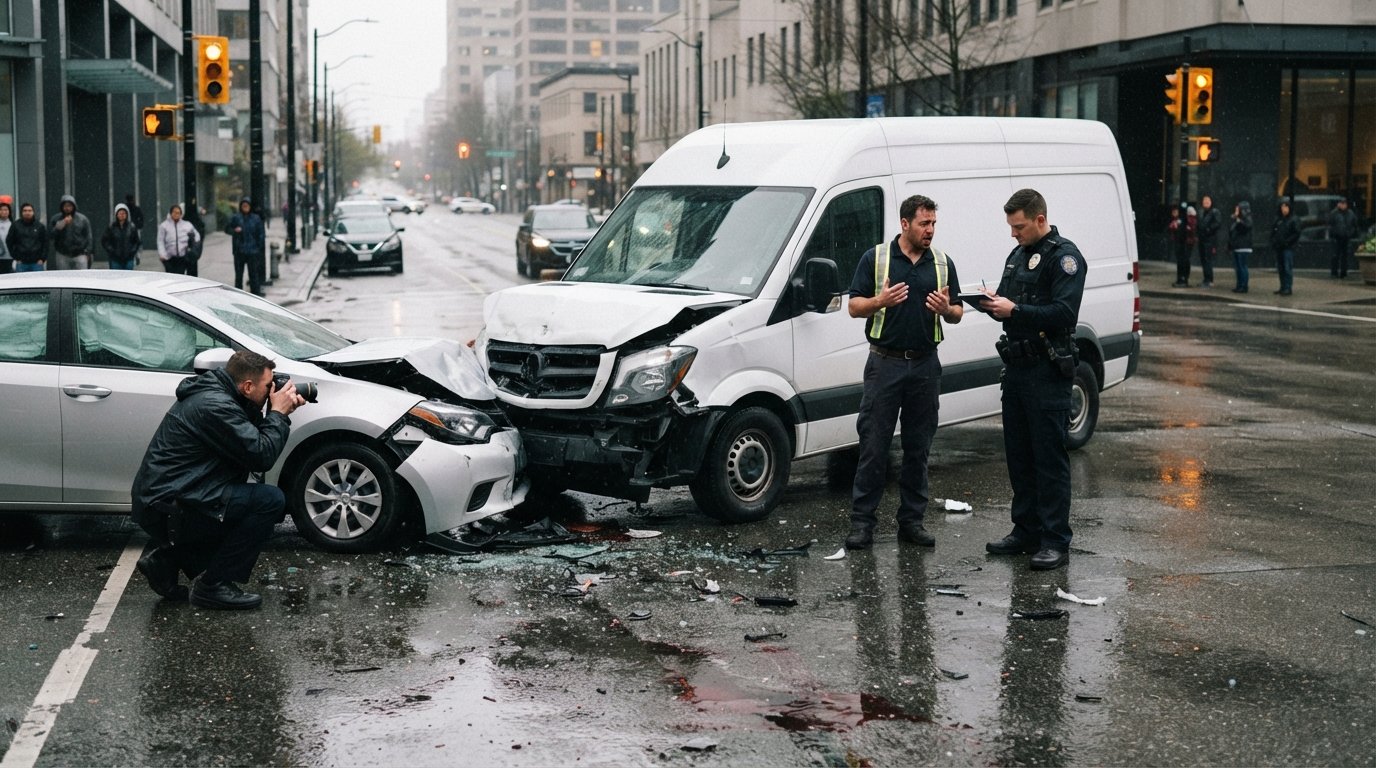
A collision with a company van or a fleet truck rarely plays out like a standard car crash. The driver may be on the clock, the vehicle may be governed by federal safety rules, and the insurance policy behind it may carry limits far beyond a personal auto policy. For injured people, that changes both the opportunity and the complexity. Commercial van and fleet vehicle accident claims demand a different investigation from day one, because the evidence that decides the case (telematics, camera footage, maintenance logs, hours-of-service records) can disappear quickly if nobody asks for it. This guide explains how liability works when a business vehicle is involved, how commercial coverage differs from personal auto insurance, and what steps protect your ability to recover fair compensation.
Why Fleet Accident Claims Are Different From Ordinary Car Crashes
In a typical two-car crash, the dispute usually centers on one question: who failed to drive safely? With a commercial van or fleet vehicle, that question expands. You are no longer dealing only with a driver, you are dealing with an employer, a safety department, a corporate insurance program, and sometimes a federal regulatory framework. The vehicle itself may be a moving office, equipped with cameras, GPS, and sensors that recorded the seconds before impact. The driver may have been pressured by delivery schedules or dispatch quotas. Each of these facts can create additional defendants and additional sources of recovery.
Commercial van and fleet vehicle accident claims also move faster on the defense side. Companies that operate fleets, especially large ones, often have risk managers and outside counsel who begin investigating within hours. They preserve their own evidence, contact their driver, and prepare a liability narrative before the injured person has even left the emergency room. That asymmetry is the single biggest reason fleet cases require early, organized legal action.
Fleet operations are not all the same, either. The legal rules that apply to a plumber's work van can differ sharply from those that apply to a tractor-trailer or a passenger-carrying shuttle. Understanding which category the vehicle falls into is the first real step in building a claim.
Common Carrier Versus Non-Carrier Fleet Operations
The most important early distinction is whether the vehicle operates as a common carrier or as a non-carrier fleet vehicle. A common carrier is a business that transports passengers or freight for hire and holds itself out to the public as doing so. Examples include delivery companies, bus and shuttle services, limousines, and for-hire trucking companies. Common carriers are held to a heightened duty of care in most states. They must exercise the highest degree of care consistent with the nature of their business, which means courts expect more from them than from an ordinary driver.
Non-carrier fleets include company cars assigned to sales staff, service vans used by technicians, and work trucks owned by contractors. These businesses are not in the transportation business, but they still owe the public a duty of reasonable care, and they still carry commercial auto policies. The carrier versus non-carrier distinction matters because it shapes the standard of care, the regulations that apply, and sometimes the insurance obligations involved.
There is a third category worth knowing: vehicles operating under federal motor carrier safety rules even when the business does not think of itself as a trucking company. A van or light truck that crosses state lines for commercial purposes may fall under federal hours-of-service and maintenance requirements. Determining which rules apply usually requires a lawyer who can review the vehicle's registration, the company's operating authority, and the driver's logs.
Vicarious Liability and Negligent Hiring Claims Against Employers
When a company driver causes a crash, the employer is often liable under a legal doctrine called respondeat superior, which holds an employer responsible for wrongful acts committed by employees within the scope of their employment. If the driver was making deliveries, driving to a job site, or running a work errand at the time of the crash, the employer is usually on the hook for the resulting damages. This is the backbone of most commercial van and fleet vehicle accident claims.
Scope of employment can become contested. Employers sometimes argue the driver was on a personal detour, commuting, or acting outside authority. A skilled investigation can rebut those arguments using dispatch records, delivery manifests, GPS data, and the driver's own statements. Even a short deviation from the route does not automatically take the driver outside the scope of employment in many jurisdictions.
Beyond vicarious liability, injured people can pursue direct negligence claims against the employer. These claims assert that the company's own conduct caused the crash, independent of the driver's momentary mistake. Common theories include:
- Negligent hiring: the company failed to check the driver's record, license status, or background before putting them behind the wheel.
- Negligent training: the driver was never properly trained on safe operation, loading, or company procedures.
- Negligent supervision: the company knew or should have known about risky driving patterns and did nothing.
- Negligent maintenance: the vehicle had known defects, worn tires, or overdue repairs that contributed to the crash.
- Negligent entrustment: the company gave a vehicle to a driver it knew was unsafe or unqualified.
These direct claims matter because they can unlock punitive damages in egregious cases and can defeat the employer's attempt to distance itself from the driver. They also justify broader discovery, including personnel files, safety manuals, and internal crash histories. In cases involving multiple vehicles and overlapping fault, understanding how responsibility is allocated becomes even more important, and our guide on who is responsible in multi vehicle accident claims explains how fault is sorted out when several parties are involved.
Commercial Policy Limits Versus Personal Auto Coverage
One of the most practical differences in fleet cases is money. Personal auto policies typically carry liability limits of $25,000 to $100,000 per person, sometimes a bit more. Commercial auto policies for businesses often carry limits of $1 million or higher, and larger fleets may use self-insurance or excess coverage layered on top. For a seriously injured claimant, that difference can determine whether the claim is fairly resolved or whether it is capped far below the actual harm.
Commercial policies also tend to include coverage types that personal policies lack, such as hired auto and non-owned auto coverage, which can apply when an employee drives a rental or personal vehicle for work. Cargo and garage liability endorsements may come into play depending on the business. Identifying every applicable policy is a core task in commercial van and fleet vehicle accident claims, and it is one reason a demand letter sent without a full insurance investigation often leaves money on the table.
There are complications to watch for. Some companies attempt to characterize a driver as an independent contractor to avoid vicarious liability. Others may have gaps in coverage, expired policies, or disputes between the auto insurer and a separate corporate insurer. An experienced attorney can trace the coverage stack and pursue uninsured or underinsured motorist benefits from your own policy when a commercial carrier's coverage is inadequate.
Hours-of-Service, Maintenance Records, and Regulatory Evidence
Federal and state regulations generate a paper trail that can prove or disprove negligence. For commercial vehicles subject to federal motor carrier rules, drivers must comply with hours-of-service limits that restrict how long they can drive before required rest breaks. Electronic logging devices record driving time, engine status, and location. Violations of these rules are powerful evidence: a driver who had been behind the wheel for fourteen hours before a crash is a very different defendant than one who started a two-hour shift.
Maintenance requirements create a second record trail. Commercial vehicles are subject to periodic inspection and repair standards, and companies are expected to keep maintenance files documenting brake work, tire replacement, and defect repairs. If a crash involved a brake failure or a blown tire, those records can show whether the company ignored warning signs.
Injured people should not assume these records will surface on their own. Companies control them, and some records are only preserved for limited periods under retention rules. A prompt written spoliation letter, sent by counsel, puts the company on notice that evidence must be preserved and creates consequences if it is destroyed. That letter should specifically demand:
- Onboard camera footage from the commercial vehicle and any nearby fleet vehicles.
- Telematics and GPS data covering the trip, including speed, braking, and idle time.
- Driver logs, electronic logging device files, and dispatch records for the day of the crash.
- Maintenance and inspection records for the vehicle going back at least two years.
- The driver's qualification file, including license checks, training records, and drug and alcohol testing history.
Each item can be decisive. Camera footage often shows exactly what happened in the seconds before impact, undercutting a driver's version of events. Telematics can reveal speeding or hard braking that the driver denies. Together, this evidence shifts the negotiation dynamic, because insurers value claims differently when liability is documented rather than alleged.
Preserving Onboard Camera and Telematics Evidence
Camera and telematics data are perishable. Many fleet systems overwrite footage after a set period, sometimes as short as seven to thirty days, and telematics vendors may retain data only briefly unless a preservation request arrives. Trucking companies with sophisticated safety programs often download data immediately after a crash, which means the defense may have evidence you will never see unless your lawyer requests it formally.
There is also a strategic dimension. Onboard cameras sometimes capture evidence helpful to the injured person, such as a driver looking down at a phone or running a red light. But the same footage can be ambiguous, and an early, poorly framed request may allow the company to prepare explanations. The best practice is to send a targeted preservation demand through counsel, then obtain the data through formal discovery so it can be authenticated and used at trial if needed.
Telematics data deserves special attention in commercial van and fleet vehicle accident claims because it can reconstruct speed, braking, acceleration, and route history with precision. In one common scenario, a delivery van strikes a pedestrian in a crosswalk and the driver claims to have been traveling at the speed limit. Telematics may show the van was moving well above the posted limit and that the driver braked only a fraction of a second before impact. That kind of objective proof is difficult for an insurer to dispute.
Steps to Take After a Fleet Vehicle Accident
The actions taken in the first days after a crash often determine the strength of the claim. The following sequence gives injured people a practical framework while they arrange legal representation.
- Get medical care and document injuries. Call 911, accept transport if recommended, and follow up with a doctor. Insurance adjusters scrutinize gaps in treatment.
- Identify the vehicle and the company. Note the company name, DOT number if visible, license plate, and any logo or signage. Photograph the vehicle, the scene, and your injuries.
- Collect witness information. Names and phone numbers of independent witnesses are invaluable, especially in disputed liability cases.
- Avoid recorded statements to the company's insurer. You are not required to give a recorded statement to the other side's carrier, and early statements often harm claims.
- Contact a lawyer quickly. Early legal involvement allows a preservation letter to go out before camera and telematics data are overwritten.
If you are unsure where to start, a free legal help and attorney-matching service such as GoFreeLegal can connect you with participating attorneys who handle commercial vehicle claims, at no cost to describe your situation. The key is to act before evidence disappears, not after the insurance company has finished building its file.
Damages Available in Commercial Van and Fleet Claims
Recoverable damages in these cases generally mirror those in other injury claims, but the scale can be larger because commercial policies and corporate defendants support bigger recoveries. Economic damages include medical bills, future medical care, lost wages, and reduced earning capacity. Non-economic damages include pain and suffering, emotional distress, and loss of enjoyment of life. In cases involving severe injury or gross negligence, punitive damages may be available to punish the company and deter similar conduct.
Wrongful death claims may arise when a fleet vehicle crash is fatal, and surviving family members can pursue funeral expenses, loss of financial support, and loss of companionship. Because commercial defendants often have the resources to litigate aggressively, proving damages thoroughly through medical records, vocational experts, and life care planners is essential. A claim that is well documented from the beginning is much harder for a corporate insurer to discount.
It also helps to understand how fault is apportioned when more than one driver contributed to the crash. Comparative fault rules vary by state and can reduce recovery if the injured person shares some responsibility. An attorney can evaluate those rules early and structure the claim accordingly.
Statutes of Limitations and Notice Requirements
Every state sets a deadline for filing personal injury lawsuits, typically two to three years from the date of the crash, though some states are shorter. Missing that deadline usually destroys the claim. Claims against government entities, such as a city transit van or a publicly owned fleet vehicle, often require a formal notice of claim within a much shorter window, sometimes as little as sixty to one hundred eighty days.
Commercial van and fleet vehicle accident claims can also involve contractual notice provisions or insurance policy conditions that affect timing. Because these deadlines are unforgiving and fact-specific, anyone injured by a company vehicle should consult an attorney promptly rather than waiting to see whether symptoms resolve or whether the insurer makes a fair offer on its own.
How an Attorney Builds a Fleet Accident Case
A lawyer handling a commercial vehicle claim typically begins by identifying every potentially liable party: the driver, the employing company, the vehicle owner if different, a leasing company, a maintenance contractor, and sometimes a cargo loader. Next comes the evidence phase, where preservation letters, public records requests, and formal discovery are used to secure camera footage, telematics, maintenance files, and personnel records. Accident reconstruction experts may be retained to analyze speed and impact forces, and medical experts document the extent of injury.
With the facts established, the attorney can pursue the full insurance stack, negotiate from a position of documented liability, and file suit if the carrier refuses a fair resolution. The goal is not simply to settle, but to settle for an amount that reflects the actual harm, which is why the thoroughness of the investigation matters so much in fleet cases.
If you were hurt by a company van, delivery truck, or fleet vehicle, do not wait for the company's insurer to dictate the outcome. Preserve the evidence, protect the deadlines, and get a clear assessment of your rights from a qualified attorney who handles commercial vehicle claims. The earlier the investigation begins, the stronger your position will be.