
What Evidence Proves Fault in a Lane Change Accident?
What evidence proves fault in a lane change accident? Dashcam video, witnesses, and damage patterns top the list. Call 8555452917 for a free case review.

By Nymera Solis
A lane change that goes wrong can turn an ordinary commute into a tangle of conflicting stories. One driver insists the other cut them off, while the other claims the first driver sped up to block them. When insurance adjusters and juries have to sort out who caused the crash, they do not rely on who sounds more convincing. They rely on evidence. Understanding what evidence proves fault in a lane change accident gives you a real advantage, because it tells you exactly what to preserve, what to request, and how to argue your case from a position of strength.
Lane change collisions are among the most fact-intensive crashes in personal injury law. The law generally places a heightened duty on the driver who moves into another lane, which means the evidence you gather in the first days after the crash often decides whether a claim is paid fairly or denied outright. If you were hurt, the burden of building that record should not fall on you alone. CarInjuryAccident.com connects injured people with experienced attorneys through a patented selection process, and a private, no-obligation case review can be requested in minutes.
Why Lane Change Accidents Are So Hard to Sort Out
Most crashes leave behind physical clues that tell a fairly clear story. A rear-end collision, for example, usually points to the following driver because of the duty to maintain a safe distance. A lane change crash is different. The point of impact is often along the side of one or both vehicles, the damage can look minor in photos, and both drivers frequently accuse each other of the same thing: unsafe movement or failure to yield. Because the vehicles are moving sideways relative to each other, there are rarely skid marks that clearly establish who moved into whom.
This ambiguity is exactly why insurance companies investigate lane change claims so aggressively. An adjuster who can raise even a small question about your driving can reduce your payout or deny the claim. That is also why the evidence you collect matters so much. A single clear piece of proof, such as dashcam footage or an independent witness statement, can be worth more than ten pages of argument.
The legal backdrop reinforces this. In nearly every state, a driver changing lanes must make sure the move can be made with reasonable safety and must yield to traffic already in the lane. When that duty is breached and a crash results, the moving driver is usually found at fault, unless the other driver was doing something reckless or unlawful. To learn how speed interacts with these rules, see this guide on how to prove fault and get paid in a speeding accident claim, which covers many of the same evidentiary principles.
The Strongest Categories of Evidence in a Lane Change Case
Not all evidence carries the same weight. Some items are close to conclusive, while others merely support the overall picture. The most persuasive evidence tends to fall into a handful of categories, and a strong claim usually combines several of them. If you can gather even two or three, you are in a far better position than someone relying on memory alone.
- Video footage: Dashcams, surveillance cameras from nearby businesses, and even doorbell cameras can capture the moment of the lane change.
- Independent witness statements: A neutral driver or pedestrian who saw the crash is extremely valuable because they have no stake in the outcome.
- Physical evidence at the scene: Debris fields, scraped paint, and gouge marks can indicate the angle and location of impact.
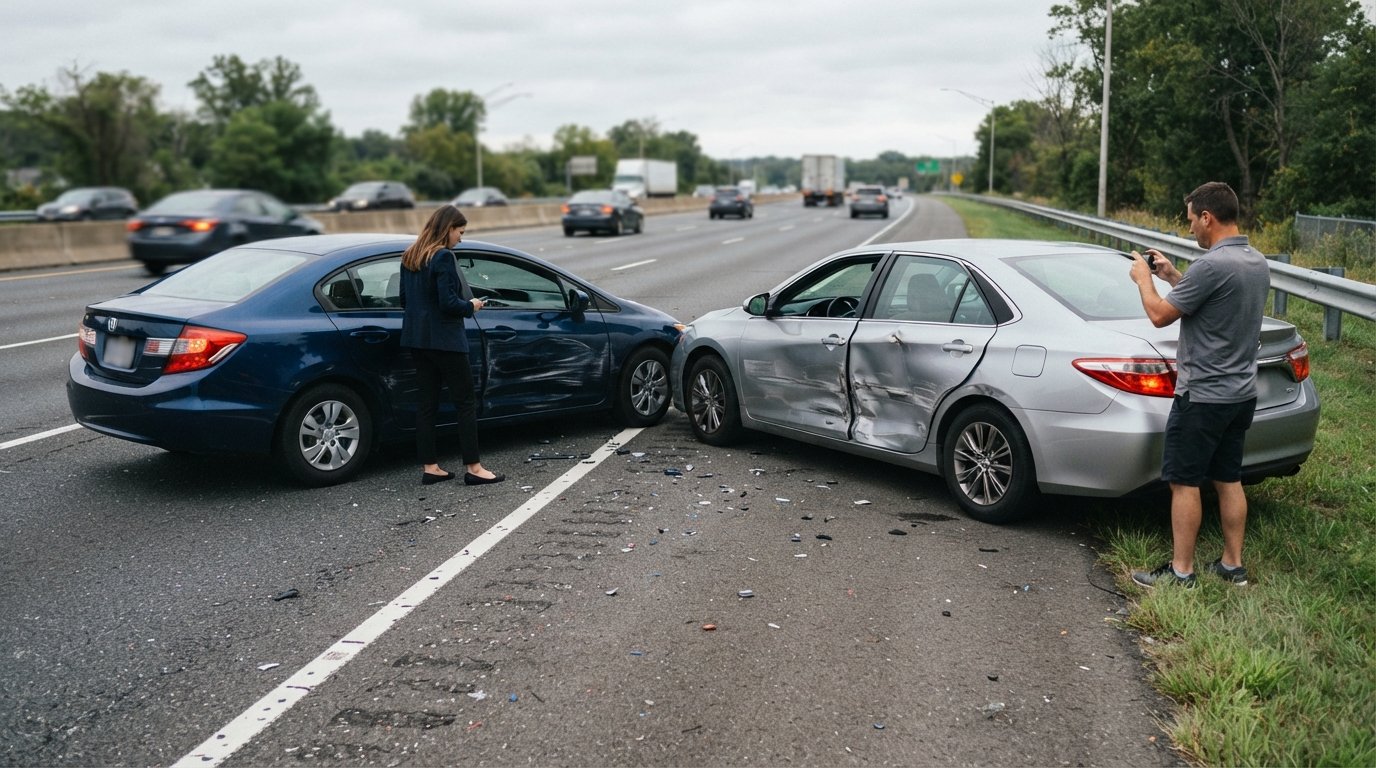
- Vehicle damage patterns: Side-swipe damage on one car and front-corner damage on the other often reveals which vehicle was moving into which lane.
- Electronic data: Event data recorders, GPS logs, and phone records can establish speed, braking, and timing.
Each of these items tells part of the story, and together they can lock down fault. Video is usually the most powerful because it removes ambiguity. Witnesses are second because they are independent. Physical and damage evidence is valuable because it is objective and hard to dispute. Electronic data is increasingly important in newer vehicles, and many attorneys now send preservation letters early to keep that data from being overwritten.
Statements, Reports, and the Paper Trail
What people say immediately after a crash, and what gets written into official reports, often shapes the entire claim. The responding officer's report is not automatically admissible in every state, but it still carries weight with adjusters and can guide the investigation. The officer's diagram, in particular, often shows vehicle positions, the point of impact, and the lane configuration, which can support or undermine a claim about who moved into whom.
Your own statements matter just as much. Anything you say at the scene, to the other driver, to the police, or to an insurance adjuster can be used against you. Even a polite apology or a vague "I did not see you" can be twisted into an admission. For that reason, attorneys routinely advise crash victims to stick to facts, avoid guessing about fault, and decline recorded statements to the other driver's insurer until they have legal guidance.
Medical records and treatment timelines also function as evidence, though indirectly. Gaps in treatment or inconsistent descriptions of how the crash happened can be used to attack your credibility, which in turn makes the fault question harder to win. Consistency across your crash account, your medical history, and your claim paperwork is one of the quiet but powerful ways to strengthen a lane change case.
How Fault Is Actually Decided in Lane Change Crashes
Fault in a lane change accident is usually decided by applying a few core rules to the evidence. The first is the duty of the lane-changing driver to yield. The second is the duty of all drivers to avoid a collision when they reasonably can. The third involves state-specific rules on comparative or contributory negligence, which determine how a percentage of fault gets assigned and what that does to your recovery.
In practice, the analysis unfolds something like this:
- Establish the lane positions and movements of both vehicles just before impact.
- Identify which driver was changing lanes and whether the maneuver was signaled and safe.
- Check whether the non-changing driver did anything unlawful, such as speeding or aggressive driving.
- Compare the physical and electronic evidence against both accounts.
- Assign percentages of fault under the state's negligence rules.
Most states use some form of comparative negligence, meaning you can recover damages even if you share some fault, as long as your share is below a certain threshold (often 50 percent or 51 percent, depending on the state). A handful of states still use contributory negligence, which bars recovery entirely if you are even slightly at fault. Because these rules vary so much, a local attorney's read on the evidence is often what determines whether a claim is worth pursuing and how it should be framed.
This is also where structured legal resources can help. Platforms such as FormsByLawyers legal resources give consumers access to document tools and connections with third-party legal professionals, which can be useful when you are trying to organize evidence and understand your options before speaking with an attorney.
Steps to Preserve Evidence Before It Disappears
Evidence in lane change cases has a short shelf life. Surveillance video is often overwritten within days or weeks. Event data recorders can be cleared. Witnesses forget details or move on. If you wait to act, you may lose the very proof that would have settled the fault question in your favor.
Here is a practical sequence that protects your claim:
- Call 911 and request a police report at the scene if you are able.
- Photograph all vehicles from multiple angles, plus the road, lane markings, and any debris.
- Collect names and contact information from every witness, not just the ones who agree with you.
- Note nearby businesses and ask whether they have cameras facing the road.
- Notify your own insurer promptly and avoid giving a recorded statement to the other side.
- Contact an attorney early so preservation letters can be sent to the other driver, the insurer, and any business with video.
If you were seriously injured, this sequence is not optional. It is the foundation of your case. An attorney can handle the preservation demands, request the police report, and coordinate with accident reconstruction experts if the fault question is genuinely contested. For most injured people, that support is available at no upfront cost because personal injury attorneys work on contingency.
How an Attorney Turns Evidence Into Recovery
Collecting evidence is only half the battle. The other half is presenting it in a way that persuades an adjuster or a jury. Attorneys do this by building a coherent timeline, mapping each piece of evidence to a specific legal duty, and anticipating the counterarguments the other side will raise. They also know when to bring in experts, such as accident reconstruction specialists or biomechanical engineers, to explain what the physical evidence means.
Beyond fault, an attorney works to document the full scope of your damages, including medical bills, lost wages, pain and suffering, and future care needs. Fault evidence and damage evidence reinforce each other: a strong liability case pressures the insurer to pay fairly, and a well-documented injury claim ensures that payment reflects what you actually lost. If you are ready to see what a tailored evaluation looks like, you can request a free, confidential case review through CarInjuryAccident.com and be matched with a participating attorney in your state.
One final point deserves emphasis. The other driver's insurer is not on your side, no matter how friendly the adjuster sounds. Their job is to minimize what they pay. The evidence you preserve and the representation you choose are the two biggest levers you control. Use both wisely, and a confusing lane change crash becomes a claim with a clear, provable story.