
DUI Blood Test vs Breath Test: Which Is More Defensible?
DUI blood test versus breath test which is more defensible often turns on records and chain of custody. Call (855)-545-2917 for a free case review.

By Kaelen Virex
You are staring at a chemical test result that says your blood alcohol concentration was over the legal limit. Maybe you blew into a breathalyzer at a roadside stop, or perhaps a phlebotomist drew your blood at a hospital or jail. Either way, that number now feels like a locked door between you and your future. But here is what most people never hear: neither test is infallible, and the question of DUI blood test versus breath test which is more defensible depends far less on the machine and far more on the paper trail behind it. Breath tests can be undermined by calibration drift and operator error, while blood tests can collapse under broken chain of custody or lab certification gaps. The stronger defense is usually the one that attacks the weakest link in the prosecution's own evidence chain. Understanding how each test fails is the first step toward building a defense that actually holds up in court.
How Breath and Blood Tests Differ in Accuracy and Error Sources
A breath test estimates alcohol in your breath and then converts that estimate into a blood alcohol concentration using a partition ratio. That conversion assumes a fixed relationship between alcohol in your breath and alcohol in your blood, but real human bodies do not always cooperate with averages. Body temperature, breathing patterns, mouth alcohol, and even the presence of certain substances can skew the reading. The machine itself is only as reliable as its calibration, and many breathalyzers are sensitive to environmental conditions and maintenance schedules that are easy to neglect.
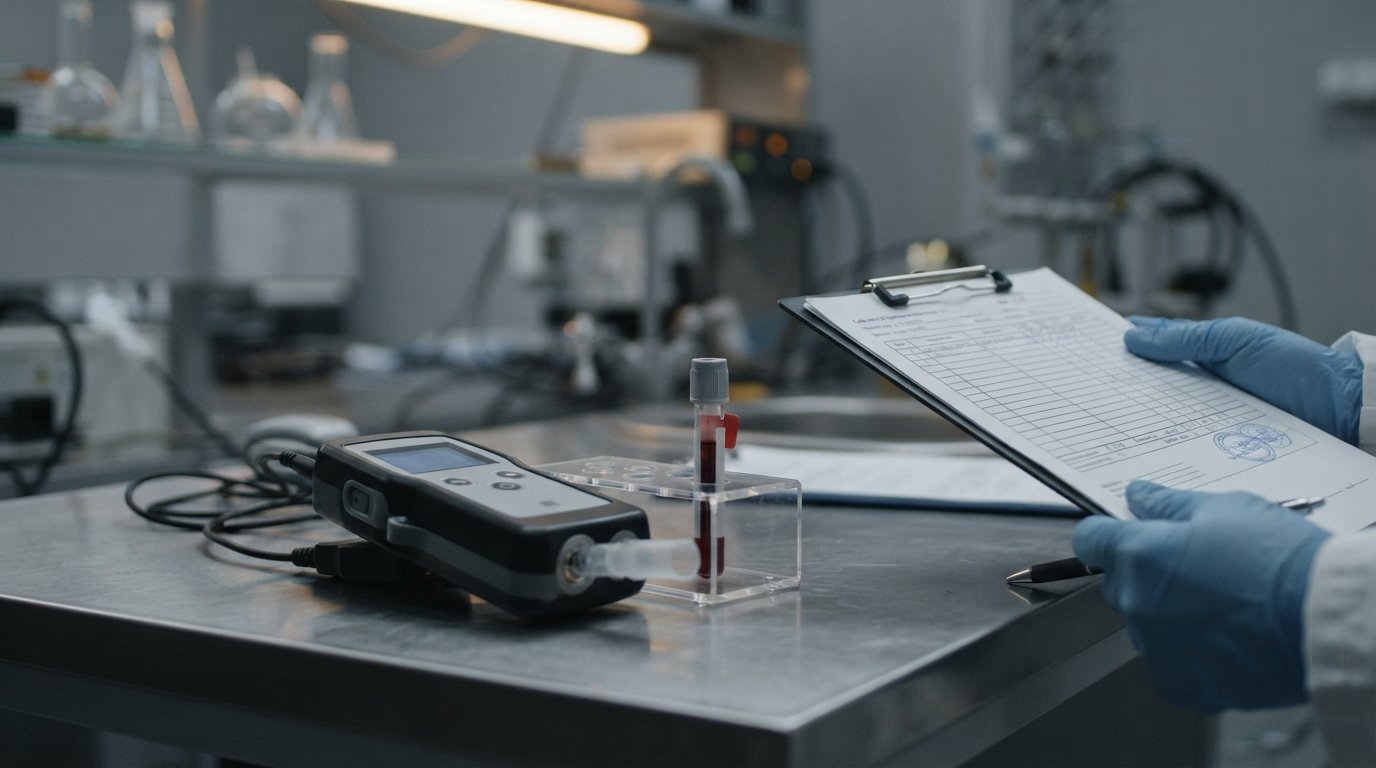
A blood test, by contrast, directly measures alcohol in a blood sample. On paper, that sounds more accurate, and often it is. But accuracy in the lab is not the same as accuracy in the courtroom. Blood draws involve a phlebotomist, a sterile kit, a preservative, a storage temperature, a courier, a laboratory, and a technician. Every one of those steps is a potential failure point. A perfectly measured sample means nothing if the vial sat in a hot car for six hours or if the lab used an expired solvent.
Here is a quick comparison of the main error sources for each test type:
- Breath test error sources: improper calibration, mouth alcohol from recent drinking or dental work, radio frequency interference from police radios, operator error, and failure to observe a required deprivation period before testing.
- Blood test error sources: improper draw technique, wrong vial or preservative, delayed or unrefrigerated transport, laboratory certification lapses, expired reagents, and chain of custody gaps.
Neither list is exhaustive, but the pattern matters. Breath test defenses tend to focus on the machine and the officer. Blood test defenses tend to focus on the sample and the lab. Which approach wins more often depends on what records the prosecution can actually produce and how well those records survive scrutiny.
Challenging Breathalyzer Maintenance and Calibration Records
The breathalyzer on the wall of the police station is not a self-contained truth machine. It requires periodic calibration, maintenance, and certification, and those records are supposed to be available to the defense. When they are missing, incomplete, or inconsistent, the test result loses its foundation. A calibration that is several months overdue or a maintenance log with unexplained gaps can create reasonable doubt about whether the machine was measuring accurately on the night you were tested.
Breath test challenges also focus on the observation period. Officers are generally required to watch a subject for a set period before testing to rule out mouth alcohol from burping, vomiting, or recent consumption. If the officer cannot testify credibly about that observation period, the result becomes vulnerable. The same goes for the simulator solution used to verify the machine, the operator's certification, and whether the device was ever repaired after a known malfunction.
These challenges are not theoretical. In many jurisdictions, breath test results have been thrown out entirely after courts discovered that maintenance records were falsified or that a specific device model had known reliability problems. If you are facing a breath test result, the defense question becomes: can the state prove the machine was working properly, that the operator followed procedure, and that the observation period was honored? If any of those answers is shaky, the breath test may be the more defensible target.
For a deeper look at how these records are attacked in practice, see our guide on challenging breathalyzer calibration and blood chain of custody. It walks through the specific documents your attorney should demand and the gaps that most often lead to suppression.
Blood Draw Chain of Custody and Lab Certification Issues
Blood evidence lives or dies on paperwork. Chain of custody is the documented record of who handled the sample, when, and under what conditions. If that record has a gap, the prosecution may be unable to prove that the blood in the vial at trial is the same blood drawn from your arm. A missing signature, an unlogged transfer, or a courier who cannot be identified can be enough to raise doubt.
Lab certification is the second pillar. The laboratory and the individual analyst must be properly certified, and the testing method must be validated. Expired reagents, improperly stored samples, and forensic analysts who cut corners have all been exposed in DUI cases across the country. When a lab's accreditation is questioned or its internal quality controls are sloppy, the blood result becomes a liability for the prosecution rather than an asset.
There is also the question of the draw itself. Was the site cleaned properly? Was the correct vial used? Was the sample refrigerated within the required window? Each of these details is documented somewhere, and each one can be a lever for the defense. Blood tests often look more scientific than breath tests, but that appearance of precision can hide a surprising amount of human error. When the chain of custody is broken or the lab cannot prove its competence, the blood test may actually be the more defensible target.
Forensic Retesting of a Preserved Blood Sample
One significant advantage of a blood test is that a preserved sample may still exist after the arrest. That means the defense can request independent forensic retesting by a qualified laboratory. Retesting can reveal whether the original result was reproducible, whether the sample was contaminated, or whether the alcohol concentration changed during storage. It is one of the few tools that lets the defense generate its own scientific evidence rather than merely criticizing the state's evidence.
Retesting is not automatic, and the sample must have been preserved properly. But when it is available, it can be powerful. If a second lab reaches a materially different result, the prosecution's case weakens considerably. Even when the retest confirms the original number, the process often exposes documentation gaps and quality control problems that become cross examination material. Breath tests, by contrast, leave no sample behind. There is nothing to retest, so the defense must rely entirely on records and procedure.
This is a central point in the DUI blood test versus breath test which is more defensible debate. Blood evidence offers a second chance at the science. Breath evidence offers only the machine and the officer's memory. Which one is more defensible depends on whether that second chance is available and whether the sample was handled well enough to make retesting meaningful.
Why Refusal Penalties Differ Between Test Types
Every state has implied consent laws that attach consequences to refusing a chemical test. Those consequences often differ depending on whether the requested test was breath or blood. In many jurisdictions, refusing a breath test triggers a civil administrative license suspension that is separate from the criminal case. Refusing a blood test can carry similar or longer suspension periods, and in some states a forced blood draw may follow a refusal if certain conditions are met.
The strategic calculation matters. A breath test refusal may be easier to defend administratively because the state has no numerical result to rely on. A blood test refusal may be harder to challenge if the state can obtain a warrant and draw blood anyway. Understanding these differences before deciding how to proceed is essential, and it is one reason you should speak with a DUI attorney as soon as possible after an arrest.
Refusal penalties also interact with the criminal case. Prosecutors sometimes use a refusal as evidence of consciousness of guilt, even though the refusal may have been based on a legitimate desire to consult counsel or to avoid an unreliable test. An experienced attorney can help you navigate that tension and challenge improper use of refusal evidence.
Building a Defense Strategy Around the Weaker Test
The practical takeaway is that you do not need to prove which test is universally better. You need to identify which test in your specific case has the more attackable foundation. Start by gathering the records. For a breath test, that means calibration logs, maintenance records, operator certification, and the observation period documentation. For a blood test, that means the draw report, chain of custody forms, lab certification, and the sample's storage history.
Once the records are in hand, evaluate them against these questions:
- Can the state prove the machine or lab was properly certified and maintained on the date of testing?
- Is the chain of custody complete and free of unexplained gaps?
- Did the operator or analyst follow the required procedures without deviation?
- Is there a preserved sample available for independent retesting?
Whichever test fails those questions more dramatically is likely the more defensible target. In some cases, the answer is both: a breath test with sloppy calibration and a blood test with a broken chain of custody can each be attacked, and the combined effect may be enough to negotiate a reduction or dismissal. The key is to act quickly, because records disappear and samples degrade.
If you are weighing your options and need to connect with a DUI attorney who understands chemical test defenses, a platform like AttorneyLeads can connect you with qualified legal professionals in your area. The important thing is not to wait. The sooner an attorney reviews the records, the more likely those records will still exist and still matter.
Facing a DUI charge with chemical test evidence is stressful, but the evidence is rarely as airtight as it first appears. Breath tests can be undermined by maintenance failures and operator error, while blood tests can collapse under chain of custody gaps and lab certification problems. The question of DUI blood test versus breath test which is more defensible is ultimately a question about your specific records, your specific sample, and your specific timeline. Speak with a qualified DUI attorney, request the documentation, and build a defense around the weakest link in the state's case. That is how you turn a number on a report into an argument you can actually win.