
Hit and Run With No Witnesses: Evidence Steps That Work
No witnesses? You can still build a strong hit and run accident with no witnesses evidence steps file and pursue uninsured motorist coverage. Call (855)-545-2917 for a free case review.

By Kaelen Virex
You step off the curb, hear the screech, and then the car is gone. No one stops. No one saw a plate. In that moment, the silence is deafening, and the instinct is to assume your case is dead on arrival. It is not. A hit and run accident with no witnesses is one of the most challenging scenarios in personal injury law, but it is far from hopeless. The steps you take in the first 24 to 72 hours can mean the difference between a denied claim and a recovered settlement. This guide walks you through the exact evidence steps to build when the other driver vanishes, including how to trigger uninsured motorist coverage, how to hunt down surveillance footage, and how to use public tip programs to your advantage.
Secure the Scene and the Official Record Immediately
The most critical evidence in a no-witness hit and run is the official police report. Without a witness, the responding officer's observations become your primary corroboration. Call 911 from the scene if you are able, even if your injuries feel minor. Adrenaline masks pain, and a report filed hours later carries less weight with insurers. When the officer arrives, provide a precise description of the vehicle, the direction of travel, and any partial plate characters you recall. Ask for the report number before the officer leaves and confirm which department will handle the follow-up.
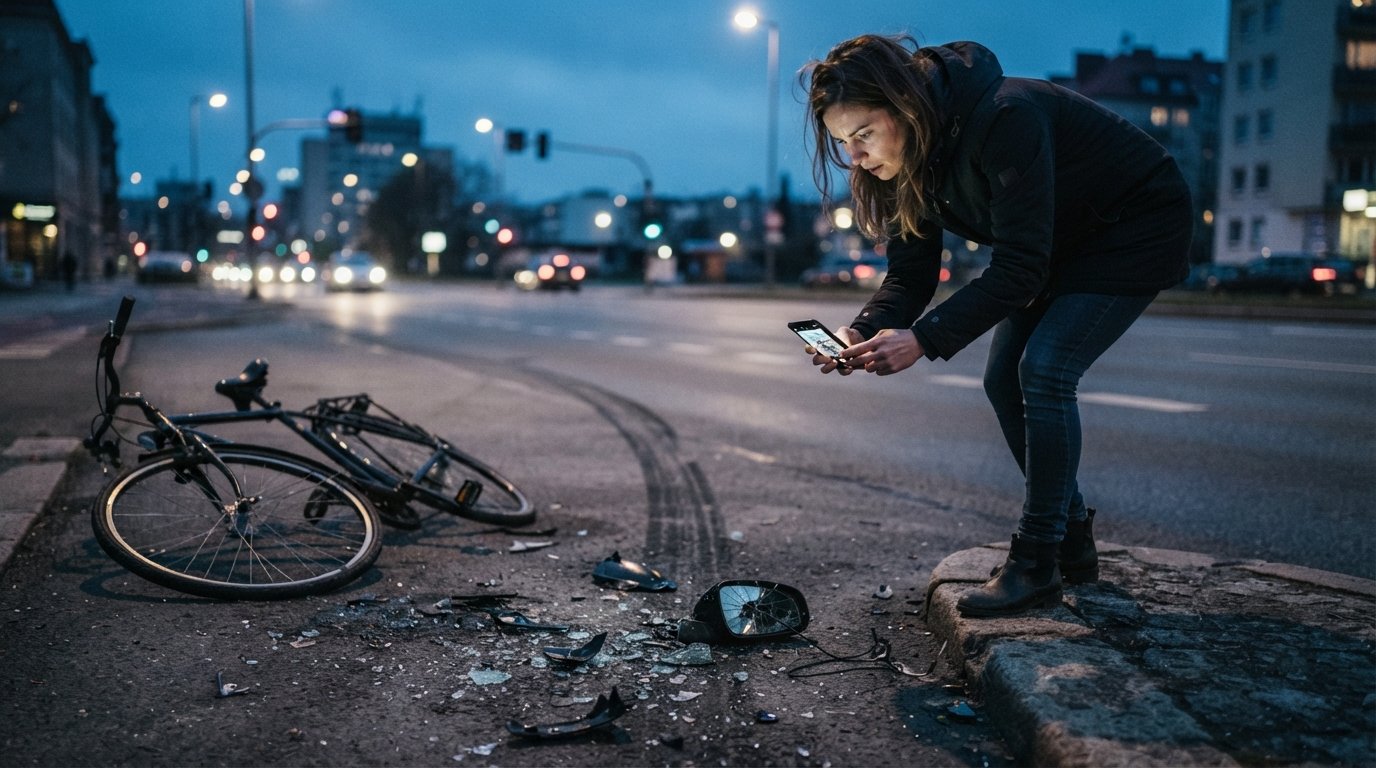
While waiting, document everything at the scene with your phone. Photograph your injuries, the damage to your vehicle or bicycle, debris scattered on the road, and the surrounding environment. Skid marks, shattered taillight plastic, and paint transfer on your clothing are all physical evidence that can later be matched to a suspect vehicle. Note the time, weather, and lighting conditions. If you were on foot, mark the exact spot where impact occurred. These details fade from memory quickly, and a timestamped photo album becomes a powerful exhibit when you file your claim.
If you are too injured to gather evidence, ask a bystander, even one who did not see the crash, to photograph the scene and collect debris in a clean container. A person who arrived seconds after impact can still testify to the position of your body or vehicle and the freshness of the skid marks. That is not a direct witness to the collision, but it is scene evidence that supports your account. For a deeper walkthrough of the claims process itself, see our guide on hit and run accident claim steps to maximize compensation.
Mine Physical Evidence: Paint Transfer, Debris, and Vehicle Parts
When there are no witnesses, physical evidence becomes your silent eyewitness. Paint transfer is one of the most underrated tools in a hit and run investigation. If the fleeing vehicle sideswiped your car, bicycle, or clothing, chips of its paint may remain on the impact surface. Do not wash or repair anything until an investigator or adjuster has documented the transfer. Photograph it with a scale reference (a coin or ruler works) and note the color, layer count, and texture. Body shops and forensic consultants can match paint composition to a specific make, model, and year range.
Debris tells a similar story. Pieces of a broken headlight, fog light bezel, or side mirror often carry part numbers stamped into the plastic. Collect them in a paper bag, not plastic, to avoid condensation and label the location and time of collection. If the part number is visible, a dealer or online parts database can identify the vehicle family. Even a fragment of a license plate bracket can narrow the search. Insurance adjusters take this evidence seriously because it is objective and difficult to dispute.
Surveillance footage is the next frontier. In urban and suburban areas, cameras are everywhere: traffic signals, gas stations, bank ATMs, doorbell cameras, and commercial parking lots. Return to the scene within 48 hours and walk the perimeter. Make a list of every business and residence with a camera facing the roadway. Ask managers politely whether they retain footage and for how long. Many systems overwrite after 72 hours, so speed matters. If a business refuses to share footage, the police can request it formally, and your attorney can send a preservation letter to prevent deletion. Doorbell camera owners are often cooperative when they understand a person was injured.
Trigger Uninsured Motorist Coverage When the Driver Is Unknown
In most states, a hit and run with an unidentified driver is treated as an uninsured motorist (UM) claim under your own auto policy. This is the financial backbone of your recovery when the at-fault driver cannot be found. UM coverage is designed for exactly this scenario, but it comes with strict conditions. You must report the accident to the police promptly, usually within 24 to 72 hours, and you must notify your insurer within the time frame stated in your policy. Failure to meet these notice rules can give the insurer grounds to deny the claim, even when the crash was clearly not your fault.
Physical contact is another common requirement. Many policies require that the hit and run vehicle actually strike you or your vehicle, not just force you off the road. If you swerved to avoid a phantom vehicle and crashed without contact, coverage may be disputed. Document any contact points with photos and repair estimates. If there was no contact, gather evidence that the other vehicle's presence caused the evasive maneuver, such as skid marks, witness statements from after the fact, or dashcam footage from a nearby vehicle. Some states allow phantom vehicle claims with corroborating evidence, but the burden is higher.
UM claims also require proof that the other driver was at fault and that you were not. Without a witness, your own testimony and the physical evidence must carry that burden. Keep a detailed personal log of the crash, your injuries, medical treatment, and any conversations with police or insurers. This log becomes the narrative thread that ties the evidence together. If your insurer delays, lowballs, or denies a valid UM claim, an attorney can pressure them and, in some cases, pursue a bad faith claim. The stakes are high because UM limits often mirror your liability limits, and stacking multiple policies can increase the available coverage.
Use Public Tips and Hit and Run Reward Programs
You do not have to solve the case alone. Many communities operate hit and run reward programs through Crime Stoppers or local police departments. These programs allow anonymous tips and pay cash rewards for information leading to an arrest or conviction. Ask the investigating officer whether a reward is available and how to publicize it. A modest reward can loosen tongues in neighborhoods where people are reluctant to get involved. Social media can amplify the effort: post a clear description of the vehicle, the time and location, and a request for dashcam or doorbell footage. Local community groups and news outlets often pick up these stories, increasing the chance that someone comes forward.
When you receive a tip, do not confront the suspected driver yourself. Report it to the police and let them investigate. Confrontation can escalate, destroy evidence, or give the driver time to repair or hide the vehicle. If the tip leads to an identification, the police can obtain a search warrant for the vehicle and match paint, debris, or damage. Even if the driver is never found, the effort demonstrates to your insurer that you pursued every avenue, which strengthens your UM claim. Keep a record of all tips, posts, and reward efforts to show good faith.
Public pressure also has a commercial dimension. Businesses with cameras may be more willing to cooperate when they know the community is watching. News coverage can prompt a body shop or tow yard employee to report a suspicious repair. The goal is to create multiple independent pathways to identification, because no single tip is guaranteed. Treat every lead as a piece of a larger puzzle, and let law enforcement assemble the final picture.
Deadlines, Notice Rules, and Legal Representation
Hit and run cases are governed by a web of deadlines that can quietly extinguish your rights. The statute of limitations for personal injury varies by state, typically ranging from one to three years, but UM claims often have shorter contractual notice periods. Some policies require notice within 30 days, and some require prompt cooperation with the insurer's investigation. Police report deadlines for UM claims are even tighter in certain states. If you miss a notice deadline, the insurer may deny coverage regardless of the merits. Calendar every deadline the moment you learn it, and send notices by certified mail or another trackable method.
Evidence preservation is a parallel deadline. Surveillance footage, vehicle repairs, and medical records can disappear if no one asks for them in time. Send written preservation requests to businesses, the police department, and your insurer. If you are unable to do this yourself, an attorney can send letters on your behalf and follow up. In a no-witness case, the paper trail is your best friend. Every request, response, and follow-up should be documented in writing.
If the investigation stalls or your insurer disputes coverage, legal representation can change the trajectory. Attorneys have tools that individuals do not, including subpoena power, access to forensic experts, and the ability to negotiate with insurers from a position of strength. They can also identify whether additional coverage exists, such as medical payments coverage, personal injury protection, or umbrella policies. For law firms seeking to reach clients in these situations, platforms like AttorneyLeads provide pre-screened legal leads, but for injured individuals, the priority is finding a lawyer who handles UM claims and hit and run investigations. A free case evaluation with a participating attorney can clarify your options without obligation.
Finally, do not underestimate the value of a thorough demand package. Even without a witness, a well-organized file with police reports, scene photos, paint transfer analysis, surveillance footage logs, medical records, and a personal impact statement can persuade an adjuster to pay policy limits. Insurers respond to documentation and persistence. The more complete your evidence file, the harder it is for them to justify a low offer. Start building that file today, and treat every photo, receipt, and note as a building block for your recovery.