
How to Read an Accident Reconstruction Report in a Car Accident Claim
Master how to read an accident reconstruction report in a car accident claim to challenge fault and protect your recovery. Call (855)-545-2917 for expert guidance.

By Evren Kairo
You have just received a thick envelope from the insurance company or your attorney's office. Inside is a document filled with diagrams, formulas, and technical jargon, all claiming to explain exactly how the crash happened. This is an accident reconstruction report, and its conclusions can mean the difference between a full settlement and a denied claim. Knowing how to read an accident reconstruction report in a car accident claim is not about becoming an engineer. It is about understanding the story the numbers tell, spotting the assumptions behind them, and knowing when to question the conclusions that could cost you your recovery.
What an Accident Reconstruction Report Actually Contains
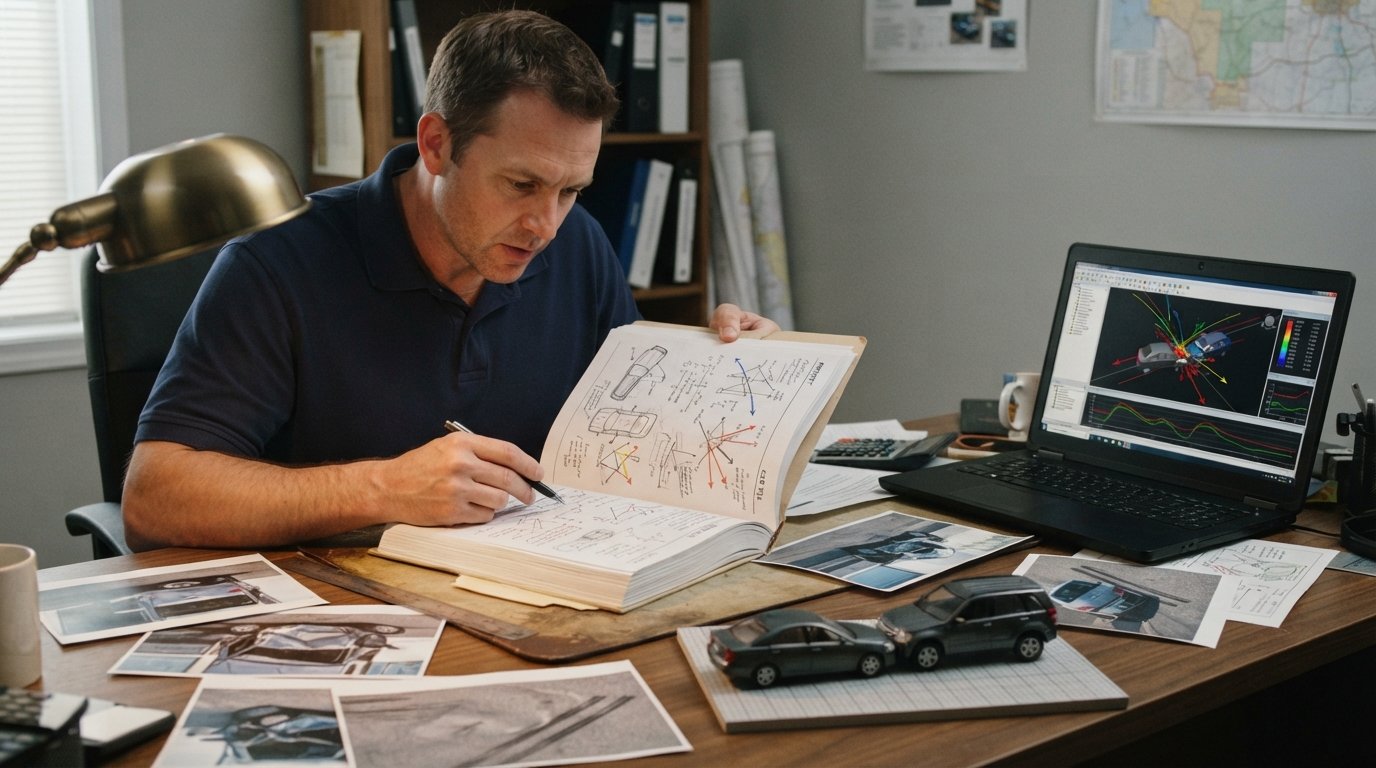
An accident reconstruction report is a forensic analysis of a collision. It is typically prepared by a specialized engineer or a certified accident reconstructionist, often hired by an insurance company, a law firm, or occasionally by the court. The report aims to answer a deceptively simple question: what happened in the seconds before, during, and after impact? To do that, the investigator gathers physical evidence such as skid marks, vehicle damage patterns, debris fields, and electronic data from the vehicle's event data recorder (often called the black box).
The final document usually includes several core components. There is a narrative summary of the investigator's conclusions, which is often the only part an insurance adjuster reads closely. There are technical sections covering speed calculations, time and distance analysis, and vehicle dynamics. You will often find collision diagrams that map the vehicles' paths, point of impact, and final resting positions. Photographs of the damage and the scene are standard, along with measurements taken at the site. Many reports also include a reconstruction methodology section explaining the formulas and software used, and a list of evidence reviewed.
Who prepares the report matters as much as what it says. If the report was commissioned by the at-fault driver's insurer, its conclusions may be shaped to minimize that insurer's exposure. If it was prepared by a neutral investigator appointed by the court, it may carry more weight, but it is still not infallible. Understanding the source helps you read the report with appropriate skepticism. A report is not a neutral truth; it is an argument supported by physics, and it can be challenged.
How Reconstruction Findings on Speed, Angle, and Braking Shape Fault
The heart of any reconstruction report is its findings on speed, angle of impact, and braking. These three factors often determine who is assigned fault and how much compensation is available. Speed findings are usually calculated from skid marks, crush damage, or event data recorder output. If the report concludes you were traveling well above the speed limit, the other side will argue you were negligent and therefore partially or fully responsible for the crash. Conversely, if the report shows the other driver was speeding, it supports your claim that their excessive speed caused the collision.
Angle of impact and vehicle positioning tell the story of who had the right of way. For example, in an intersection crash, the reconstruction may analyze the point of impact on each vehicle to determine whether one car was already in the intersection when the other entered. That finding can support or undermine a claim that the other driver ran a red light. Braking evidence, such as skid mark length and whether brake lights were illuminated, shows reaction time and whether either driver attempted to avoid the crash. A report concluding that the other driver never braked can suggest inattention or intoxication, strengthening your claim. A report concluding that you braked too late might be used to argue contributory negligence.
These technical findings feed directly into the legal concept of liability. In most states, fault can be apportioned, meaning even a small percentage of responsibility on your part reduces your recovery. A reconstruction report that assigns you 20 percent fault, for instance, could reduce a $100,000 settlement to $80,000. That is why reading the speed, angle, and braking sections carefully is essential. Look for the evidence each conclusion rests on. If the report claims a speed based on a single skid mark measurement, ask whether road conditions, tire type, and antilock brakes were accounted for. Small assumptions can produce large errors that shift fault.
Using the Report to Challenge a Disputed Liability Determination
Insurance companies often rely on reconstruction reports to deny claims or shift blame. If you receive a report that concludes you were at fault, do not accept it at face value. You have the right to challenge its findings, and a careful reading can reveal weaknesses. Start by checking whether the investigator reviewed all available evidence. Did they examine your vehicle's event data recorder? Did they interview witnesses? Did they account for road defects, weather conditions, or mechanical failures? A report built on incomplete evidence is vulnerable.
Next, scrutinize the methodology. Reconstruction science is not exact, and different experts can reach different conclusions from the same data. Look for whether the report discloses its margin of error. If a speed calculation is presented as a precise number without a range, that is a red flag. Check whether the investigator used industry-standard software and whether their credentials are current. You can also compare the report's conclusions to the physical evidence you can see, such as the damage to your car. If the report says the impact was minor but your vehicle was totaled, that inconsistency deserves explanation.
If you find flaws, you can request a rebuttal report from your own expert. In a disputed liability case, your attorney may hire an independent reconstructionist to review the same evidence and produce a competing analysis. This is often the most effective way to challenge an unfavorable report. The two reports then become part of the negotiation or litigation, and the stronger, better-supported analysis tends to prevail. Knowing how to read an accident reconstruction report in a car accident claim means knowing when to say, "This conclusion does not match the evidence, and here is why."
When to Request Your Own Reconstruction Through a Participating Attorney
You do not have to accept the insurance company's reconstruction as the final word. If liability is disputed, if the initial report seems biased, or if the stakes are high enough, requesting your own reconstruction can be a wise investment. An independent reconstruction can uncover evidence the insurer's expert overlooked, provide a more favorable speed or angle analysis, and give your attorney powerful ammunition in settlement negotiations or at trial.
However, hiring a reconstructionist is not something you should do alone. These experts can be expensive, and their reports must be prepared in a way that will withstand scrutiny. The best approach is to work through an attorney who has experience with accident reconstruction and access to qualified experts. A participating attorney can evaluate whether a second report is likely to help your case, manage the cost, and integrate the findings into your overall claim strategy. If you are unsure where to start, you can connect with free legal help to discuss your options with a professional who understands the process.
Timing also matters. Evidence degrades, vehicles are repaired or sold, and witness memories fade. The sooner you involve an attorney who can request a reconstruction, the better the chance of preserving critical data. If you are handling a rideshare accident claim, for example, the platform's policies and multiple insurance layers can complicate liability, making an independent reconstruction even more valuable. For a deeper look at that scenario, see our guide on rideshare driver injury claims.
A Practical Framework for Reading Any Reconstruction Report
When you sit down with the report, approach it systematically. Do not start with the conclusion and work backward. Instead, read the evidence sections first, then the analysis, and only then the conclusions. Ask yourself whether each conclusion is supported by the evidence you just read. This order helps you spot leaps in logic. The following steps can guide you through the document:
- Identify the author and commissioning party. Note who prepared the report and who paid for it. This context frames potential bias.
- Review the evidence list. Check whether all relevant evidence was considered: skid marks, damage photos, event data recorder, witness statements, and scene measurements.
- Examine the speed and braking calculations. Look for the stated assumptions and margins of error. A credible report acknowledges uncertainty.
- Study the collision diagram. Compare the diagram to your own memory and the physical damage. Does the diagram make sense?
- Read the conclusions last. Ask whether each conclusion follows logically from the evidence and analysis you have already reviewed.
After you have gone through these steps, write down any questions or inconsistencies. These notes will be valuable when you discuss the report with your attorney or when you request a rebuttal. Remember that you are not expected to be an expert. Your goal is to be an informed reader who can identify when something does not add up.
Common Pitfalls That Weaken a Reconstruction Report
Even well-intentioned reconstruction reports can contain weaknesses. One common pitfall is overreliance on a single piece of evidence, such as a skid mark measurement, without corroboration. Another is failing to account for vehicle damage that occurred in a secondary impact. Investigators sometimes assume ideal conditions, such as uniform road friction, when real-world conditions vary. A report that ignores these variables may reach a conclusion that is precise but inaccurate.
Another pitfall is the use of generic software defaults rather than case-specific data. For example, a reconstructionist might use an average reaction time when the evidence suggests a longer or shorter delay. These defaults can skew fault. Additionally, some reports fail to disclose the limitations of the analysis, presenting conclusions as more certain than the science allows. When you read a report, look for a limitations section. Its absence is a warning sign.
Finally, beware of reports that are essentially advocacy documents. If the language is inflammatory or the conclusions are extreme, the report may have been prepared to support a predetermined outcome. A credible reconstruction is measured, transparent about its assumptions, and open to alternative interpretations. If the report you are reading lacks these qualities, it is vulnerable to challenge.
How an Attorney Can Help You Interpret and Use the Report
Reading an accident reconstruction report is one thing; using it effectively in a car accident claim is another. An experienced attorney can help you understand the report's implications, identify weaknesses, and decide whether to request a rebuttal. Attorneys who handle car accident claims regularly work with reconstruction experts and know what to look for. They can also communicate with the insurance company on your behalf, challenging unfavorable findings and presenting your own expert's analysis.
If you are unsure whether the report you received is accurate or fair, consider getting a professional opinion. Many law firms offer free case evaluations, and platforms like CarInjuryAccident.com can connect you with participating attorneys who focus on car accident claims. These attorneys can review your report, explain your options, and help you decide on next steps. There is no obligation to hire, and the consultation is confidential. Taking this step can give you peace of mind and protect your rights.
Understanding how to read an accident reconstruction report in a car accident claim empowers you to ask better questions and make informed decisions. Whether you are negotiating with an insurer or preparing for litigation, the ability to dissect a reconstruction report is a valuable skill. Do not let technical jargon intimidate you. With a systematic approach and professional guidance when needed, you can ensure that the report supports your version of events, not the other side's.