
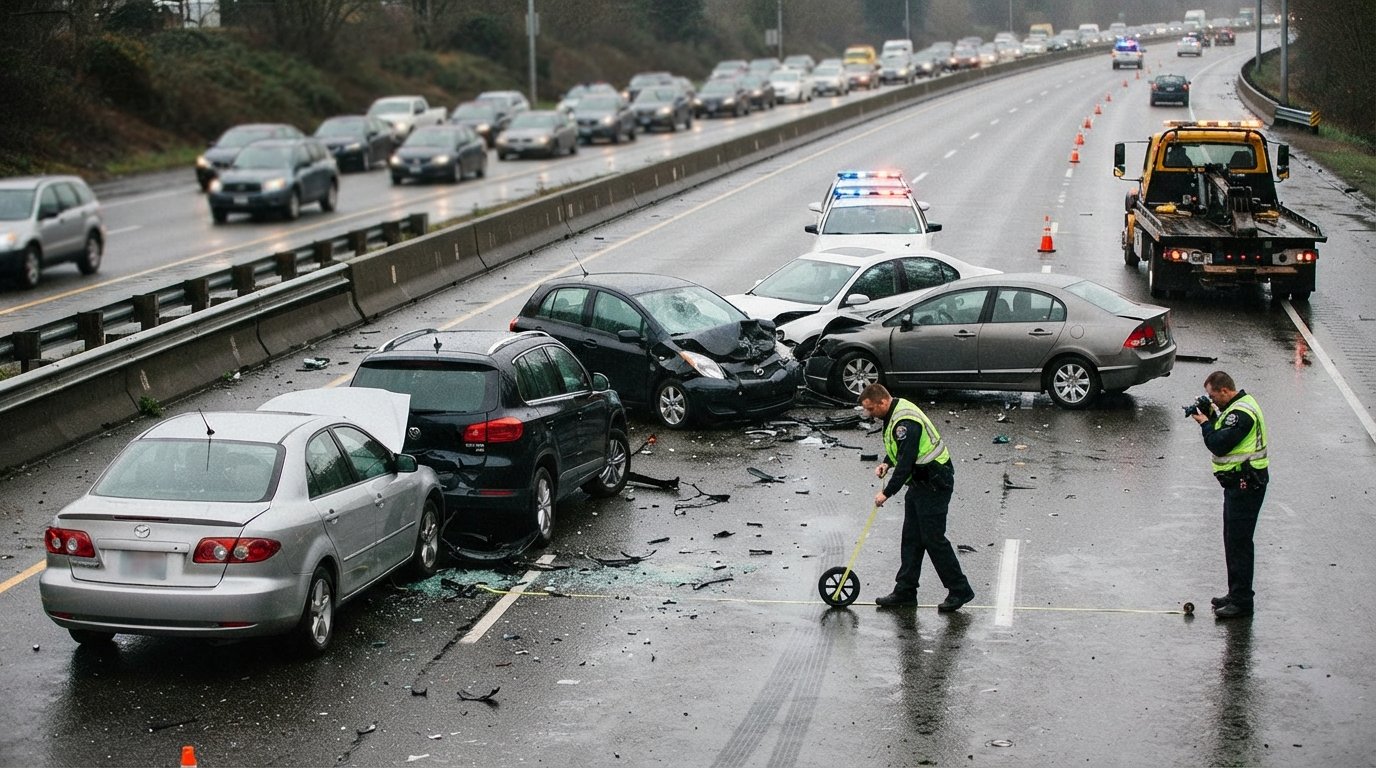
Multi-Vehicle Pile-Up: Who Is at Fault and How Claims Work
Multi-vehicle pile-up accident who is at fault and how claims work: learn to protect your recovery. Call (855)-545-2917 for a free case review.

By Lucian Vex
A sudden chain-reaction crash on the highway leaves you shaken, confused, and unsure who to call. In a multi-vehicle pile-up, determining fault is rarely as simple as blaming the last driver. Insurance companies, police, and attorneys must untangle a web of actions, reactions, and policies. This guide explains how fault is assigned in multi-vehicle accidents and how claims work so you can protect your rights and pursue fair compensation.
How Fault Is Determined in a Multi-Vehicle Pile-Up
In a typical two-car collision, fault often falls on one driver. In a pile-up involving three, five, or even a dozen vehicles, fault can be shared among multiple parties. Investigators use physical evidence, witness statements, and traffic laws to reconstruct the sequence of events. The goal is to identify who initiated the chain of collisions and whether each subsequent driver acted reasonably.
Police reports are a key piece of evidence. Officers document vehicle positions, damage patterns, skid marks, and road conditions. They may also cite drivers for violations such as following too closely, speeding, or failing to yield. However, a police report is not the final word on fault; insurance adjusters and courts conduct their own analysis.
Event data recorders (black boxes) in modern vehicles can provide speed, braking, and steering data. Surveillance cameras from nearby businesses or traffic cams may capture the crash. Attorneys often hire accident reconstruction experts to calculate impact forces and determine how the pile-up unfolded.
Why the Last Driver Is Not Always Liable
It is tempting to assume the driver at the rear of the pile-up caused everything. But that is often wrong. Consider a scenario where a driver in the middle suddenly slams on the brakes without justification, causing the car behind to rear-end them, which then triggers a chain reaction. In that case, the middle driver may bear significant fault. Or a driver who was already stopped and then negligently merged into traffic could set off a series of collisions.
Each collision within the pile-up is analyzed separately. The driver who hit the car in front may not be liable for the entire chain if they were pushed by a vehicle behind them. Liability depends on who breached a duty of care and whether that breach directly caused the harm. Insurance companies look at the "but for" cause: but for that driver's action, would the collision have occurred?
Comparative fault rules also come into play. In many states, if a driver is partially at fault, their recovery is reduced by their percentage of fault. Some states follow modified comparative fault (you can recover only if you are less than 50% or 51% at fault), while others follow pure comparative fault (you can recover even if you are 99% at fault, but damages are reduced accordingly). A few states still use contributory negligence, which bars recovery if you are at all at fault. An experienced attorney can explain which rules apply in your state.
Split-Liability Scenarios and Comparative Fault
In a multi-vehicle pile-up, fault may be split among several drivers. For example, Driver A was speeding and failed to brake in time, hitting Driver B. Driver B's car was then pushed into Driver C. Driver C had been tailgating and could not stop in time. Here, Driver A may be primarily liable for the initial impact, but Driver C's tailgating contributed to the severity of the chain. A court might assign 60% fault to Driver A, 30% to Driver C, and 10% to Driver B for sudden braking. Each driver's recovery would be reduced by their own percentage of fault.
Insurance adjusters negotiate these percentages. They may use accident reconstruction reports, witness credibility, and legal precedents. If you are injured, your attorney will fight to minimize your assigned fault so you receive maximum compensation. Even a 10% fault assignment can significantly reduce your settlement.
Evidence to Preserve at the Scene
What you do immediately after a pile-up can make or break your claim. Your memory fades, witnesses disappear, and evidence gets cleared. Preserve as much as possible:
- Dashcam or phone video: If you have a dashcam, save the footage. If not, use your phone to photograph vehicle positions, damage, skid marks, and traffic signals.
- Witness contact information: Get names, phone numbers, and email addresses of anyone who saw the crash. Ask if they are willing to give a statement.
- Vehicle positions and debris: Photograph the entire scene from multiple angles. Note where each car ended up and any debris that indicates point of impact.
- Police report number: Ask the responding officer for the report number and how to obtain a copy.
- Medical records: Seek medical attention immediately, even if you feel fine. Some injuries, like whiplash or concussions, appear hours later.
After leaving the scene, exchange insurance information with all drivers. Do not admit fault or speculate about who caused the crash. Report the accident to your own insurer promptly. Keep a file with all documents, photos, and receipts.
How Multiple Insurance Policies Stack and Which Pays First
In a multi-vehicle pile-up, multiple insurance policies may be available to cover your damages. The order in which they pay depends on state law and the specific policies. Typically, the at-fault driver's liability insurance pays first. If that driver is underinsured, your own uninsured/underinsured motorist (UM/UIM) coverage may kick in. If you were a passenger, the driver's policy may cover you, or your own policy if the driver is uninsured.
When several drivers share fault, each liability policy may pay a portion of your damages based on their insured's percentage of fault. For example, if Driver A is 60% at fault and Driver B is 40%, you might collect 60% from Driver A's insurer and 40% from Driver B's insurer. If one policy is insufficient, you may pursue other policies or your own UM/UIM coverage.
Commercial vehicles, such as trucks or ride-share cars, may have higher policy limits. If a commercial driver caused the pile-up, there may be additional coverage through the company. An attorney can identify all available policies and negotiate with multiple insurers to maximize your recovery.
Steps to File a Claim After a Multi-Vehicle Pile-Up
Filing a claim in a multi-vehicle accident is more complex than a standard two-car crash. You must deal with multiple adjusters, each protecting their insured. Here is a step-by-step approach to streamline the process:
- Report the accident to your insurer: Notify your own insurance company immediately, even if you were not at fault. Provide the police report number and details of all involved vehicles.
- Gather documentation: Collect medical records, repair estimates, photos, witness statements, and the police report. Keep everything organized.
- Identify all liable parties: Work with an attorney to determine which drivers and insurance policies are responsible. Do not rely solely on the police report.
- Send demand letters: Your attorney will send demand letters to each at-fault driver's insurer, outlining your damages and evidence.
- Negotiate settlements: Negotiations may involve multiple insurers. Your attorney will handle communication and push for fair compensation.
- File a lawsuit if needed: If settlements are inadequate, your attorney may file a lawsuit against the at-fault drivers.
Remember that insurance companies are not on your side. They may try to shift blame to you or other drivers to reduce payouts. Having legal representation levels the playing field. If you need help navigating the claims process, our guide on filing a multi-vehicle accident claim walks you through the steps in detail.
The Role of an Attorney in a Multi-Vehicle Pile-Up
An experienced personal injury attorney can be invaluable in a multi-vehicle case. They understand how to investigate complex crashes, deal with multiple insurance companies, and prove liability. They can also help you avoid mistakes that could jeopardize your claim, such as giving recorded statements or accepting low initial offers.
Attorneys work on a contingency fee basis in these cases, meaning you pay nothing upfront and only pay if they win. They can connect you with accident reconstruction experts, medical specialists, and economists to value your claim accurately. If you are struggling to find the right lawyer, platforms like LawyerOffer can connect you with qualified attorneys in your area.
At CarInjuryAccident.com, we help injured people find top-rated attorneys through our patented selection process. Our network includes lawyers who specialize in car accidents and personal injury. You can request a free, no-obligation case evaluation to discuss your options. There is no pressure to hire; the goal is to give you the information you need to make an informed decision.
Common Mistakes to Avoid After a Pile-Up
Even well-intentioned victims can harm their claims by making these mistakes:
- Admitting fault: Never say "I'm sorry" or "It was my fault" at the scene. You may not have all the facts.
- Skipping medical treatment: Injuries may not appear immediately. See a doctor within 24 hours.
- Giving recorded statements: Insurance adjusters may twist your words. Politely decline until you speak with an attorney.
- Accepting a quick settlement: Initial offers are often far below what you deserve. Consult an attorney before signing anything.
- Missing deadlines: Personal injury statutes of limitations vary by state. Do not delay.
By avoiding these pitfalls and seeking legal guidance early, you can protect your rights and improve your chances of a fair outcome.
A multi-vehicle pile-up can be overwhelming, but you do not have to face the insurance companies alone. Understanding how fault is determined and how claims work empowers you to take the right steps. If you have been injured, consider consulting with a qualified attorney who can investigate your case and fight for the compensation you deserve.