
Sobriety Checkpoint Passenger Rights After a DUI Arrest
Know your rights as a passenger during a DUI checkpoint stop. Call (855)-545-2917 to discuss your situation with a legal professional.

By Kaelen Virex
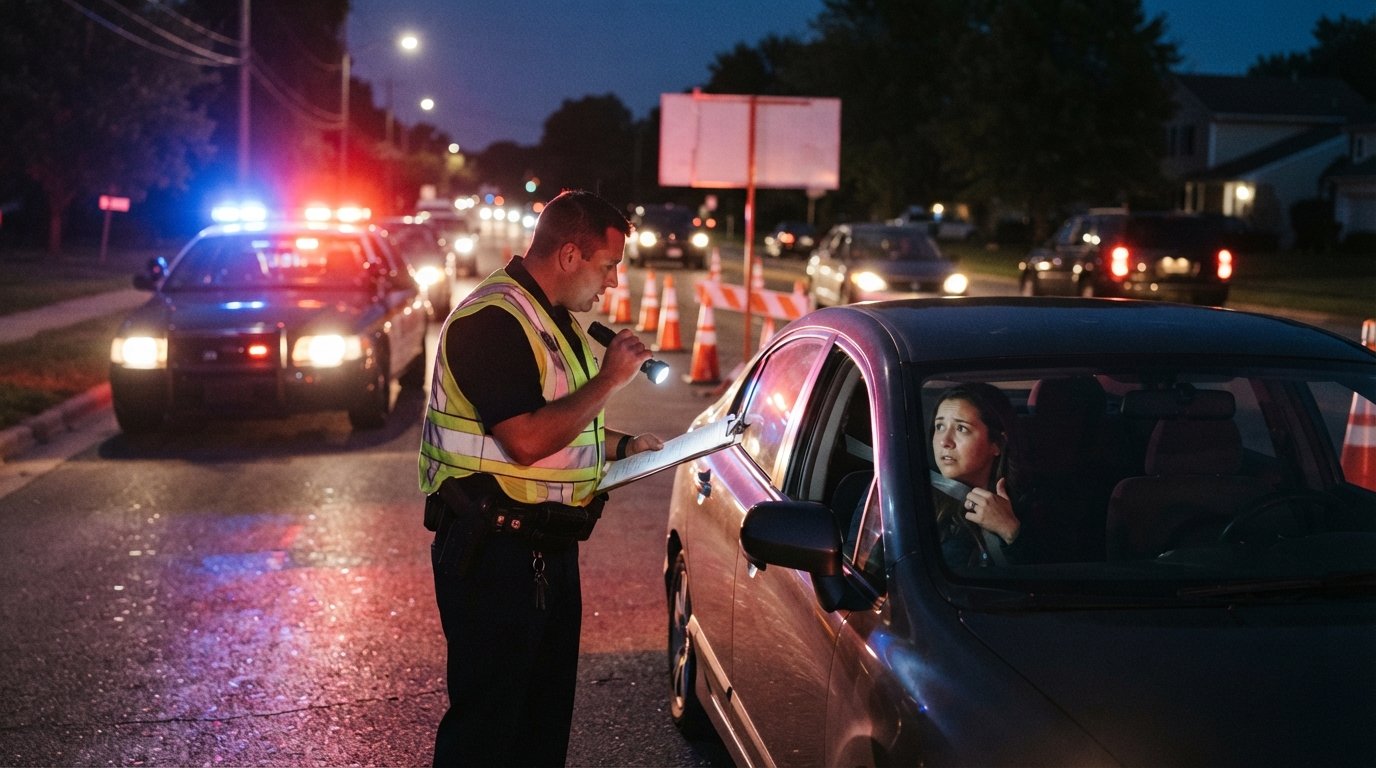
A police car pulls you over at a sobriety checkpoint. The driver has had a drink, and the officer is now asking questions that seem directed at everyone in the vehicle. If you are the passenger, your heart is racing and you are wondering what you must answer and what you can politely refuse. Understanding DUI arrest at a sobriety checkpoint passenger rights is not about helping anyone evade the law. It is about knowing the boundaries of police authority so you can respond calmly, avoid self-incrimination, and protect your own record. This guide walks through those boundaries step by step, from the first request for identification to the moment a passenger may need a separate attorney. The information is educational only and is not legal advice; every case turns on its own facts, so a consultation with a licensed lawyer is the right next step when something feels wrong.
What a Sobriety Checkpoint Is and Why Passengers Are Stopped Too
A sobriety checkpoint is a roadblock where officers briefly detain every vehicle, or a patterned selection of vehicles, to look for signs of impaired driving. The United States Supreme Court upheld these stops in Michigan Department of State Police v. Sitz (1990), reasoning that the brief intrusion is outweighed by the public interest in reducing drunk driving deaths. Because the stop applies to the vehicle rather than to one suspect, everyone inside is technically detained for the few minutes it takes officers to conduct the initial screening. That detail matters: passengers are not free to walk away from a checkpoint until the officer releases the vehicle, but the detention is supposed to be brief and limited in scope.
State rules vary widely. Some states require advance public notice of checkpoint locations, supervision by a ranking officer, and a neutral formula for deciding which cars to stop. Others allow random stops at checkpoints with fewer procedural strings. A checkpoint that departs from these rules can sometimes be challenged, but the challenge usually belongs to the driver's defense attorney, not to the passenger. For passengers, the practical question is narrower: what can an officer lawfully demand from me, and what happens if the driver is arrested? The answer begins with the difference between a brief checkpoint detention and a full investigative stop.
What Passengers Must Provide and What They Can Decline
During the initial checkpoint contact, officers typically ask the driver for a license, registration, and proof of insurance. Passengers are usually not required to hand over identification unless the officer has independent reasonable suspicion that the passenger committed a crime. In many states, a passenger may verbally state their name when asked, but refusing to produce a physical ID card is generally lawful if no statute requires it. The safest approach is calm and courteous: provide your name, avoid volunteering information, and ask whether you are free to leave. If the officer says no, you are being detained, and that fact is worth remembering.
Passengers can decline consent to a search of their belongings, such as a purse or backpack. They can also decline to answer questions beyond basic identification, including questions about how much they have had to drink or where they are coming from. The Fifth Amendment privilege against self-incrimination applies to passengers just as it applies to drivers. Saying "I prefer not to answer that question" is not an admission of guilt, and it is far better than a nervous answer that later gets repeated in a police report. The table below summarizes the common requests and the general response options, keeping in mind that state law controls the details.
- Verbal identification: Generally required in most states when an officer has reasonable suspicion; provide your name calmly.
- Physical ID card: Often not required for passengers unless a specific statute says otherwise; a verbal name may suffice.
- Answers about drinking: Can be declined; the Fifth Amendment protects against compelled self-incrimination.
- Consent to search a bag or purse: Can be refused; officers may still search if they develop probable cause or a valid exception applies.
- Exit the vehicle: Officers may order occupants out during a lawful stop for safety reasons, but that does not authorize a search of your person without more.
Notice the pattern: passengers have more room to decline than most people assume, but the room is bounded by officer safety concerns and state-specific statutes. A passenger who argues loudly or physically resists will convert a routine checkpoint into a separate criminal charge, which is the opposite of protecting one's rights. Courteous refusal, repeated as needed, is the strategy that preserves the best record for later review.
Does Passenger Intoxication Alone Create Criminal Exposure?
This is the question passengers ask most often, and the answer is reassuring in most circumstances. DUI statutes criminalize operating or being in physical control of a vehicle while impaired. A passenger who is intoxicated but not driving generally does not commit DUI merely by sitting in the passenger seat. The offense belongs to the person operating the vehicle. There are narrow exceptions, such as a passenger who grabs the wheel, who is supervising a learner driver in some states, or who takes control of a parked vehicle with the engine running. Those exceptions are fact-specific and rare at a checkpoint.
Intoxication can create exposure in other ways, however. A passenger who is visibly impaired and belligerent may attract a disorderly conduct or public intoxication charge if state law allows it. A passenger who is a minor in possession of alcohol faces separate underage drinking statutes. A passenger who lies about their identity to officers can face obstruction or false information charges. And a passenger who is on probation or parole with search conditions may have fewer protections than the average citizen. The point is that the risk to a passenger usually comes from conduct during the stop, not from the mere fact of having consumed alcohol before the stop.
One more nuance deserves attention. In some states, a passenger can be charged as an accomplice or under a theory of aiding and abetting if they knowingly entrust a vehicle to an impaired driver or encourage the driver to continue after being warned. These theories are unusual at a checkpoint because the stop happens before any continued driving, but they illustrate why passengers should never urge a driver to leave a checkpoint early or to refuse lawful orders. The cleanest position for a passenger is to remain calm, decline self-incriminating questions, and let the process unfold without interference.
Vehicle Searches and Consent Boundaries at Checkpoints
The Fourth Amendment protects people from unreasonable searches, and a checkpoint stop does not automatically authorize a search of the vehicle or its occupants. Officers may order occupants out of the car during a lawful stop for safety, and they may look through windows at what is plainly visible. They may not open closed containers, rifle through a glove box, or search a passenger's purse without consent, probable cause, or another recognized exception such as a lawful arrest incident to the stop. If an officer asks "Do you mind if I take a look?" the correct understanding is that you may say no, and the officer must then rely on a different legal basis if they search anyway.
Consent must be voluntary, and it can be limited. A passenger who says "You may look in the back seat, but not in my bag" has given partial consent, and officers who exceed that scope risk suppressing what they find. A passenger who says nothing while an officer opens a bag has not necessarily consented; silence is not consent in most jurisdictions. Drivers face a different calculus because vehicle searches can sometimes proceed under the automobile exception when probable cause exists, but that exception applies to the vehicle, not to a passenger's personal belongings. Passengers should state their objection clearly if a search exceeds what they agreed to.
Recording the interaction is a related boundary that varies by state. In many jurisdictions, the public has a First Amendment right to record police performing public duties, subject to reasonable time, place, and manner restrictions. Some states require all-party consent for audio recording, which can complicate recording a conversation with an officer. A practical approach is to record video openly, announce that you are recording, and keep the phone visible. If an officer orders you to stop recording, comply first and challenge the order later through an attorney; resisting a lawful order on the spot rarely ends well. The recording may become valuable evidence if the stop leads to a charge or a civil rights claim.
Documenting Officer Conduct and Building a Record
Memory fades, and police reports are written from the officer's perspective. Passengers who document the interaction in real time create a counter-narrative that a defense attorney or a civil rights lawyer can use. Note the time, location, and the names or badge numbers of the officers involved. Note what was asked, what you answered, and what you refused. Note whether the checkpoint had signage, whether other cars were being stopped, and whether the detention lasted longer than a few minutes. These details help a lawyer assess whether the stop complied with state checkpoint procedures.
If you are able to record, save the file to a second location immediately and do not edit it. If you are not able to record, write down your recollection as soon as you are safe, before talking to anyone else about the event. Witnesses matter too: another passenger, a rideshare driver, or a bystander may be willing to provide a statement. Photographs of the checkpoint location, signage, and any visible injuries or property damage can also be useful. The goal is not to build a case on your own but to give a lawyer the raw material needed to evaluate one.
Documentation also protects against escalation. An officer who knows the interaction is being recorded tends to follow procedure more carefully, and a passenger who is calmly taking notes is less likely to be perceived as a threat. Keep the tone neutral, avoid profanity, and never physically interfere with the officer. If you believe your rights were violated, the remedy is a later motion or complaint, not a confrontation at the roadside. For passengers injured in a crash that preceded the checkpoint, the same documentation habits support a separate civil claim; our guide on passenger accident rights after a crash explains how that claim works alongside any criminal case.
When a Passenger Needs Separate Counsel
The driver's attorney represents the driver, not the passengers. That conflict becomes obvious when the driver's defense strategy involves blaming a passenger, when the passenger faces a separate charge, or when the passenger has civil claims arising from the same incident. A passenger who is charged with any offense, even a minor one, should consult a criminal defense lawyer in that jurisdiction. A passenger who was injured because the driver was impaired should consult a personal injury lawyer about a claim against the driver, the driver's insurer, or other responsible parties. These are different practices, and a single attorney may not be able to handle both without a conflict.
Timing matters. Criminal charges move on a court schedule with short deadlines for arraignment, motions, and trial. Civil claims have statutes of limitations that vary by state and by claim type. A passenger who waits to see how the driver's case turns out may miss a deadline. A free consultation with a qualified attorney is the fastest way to learn which deadlines apply and whether a claim is worth pursuing. Platforms such as LawyerOffer connect people with attorneys who handle DUI and personal injury matters, and a no-obligation review can clarify the options without any commitment to hire.
Choosing counsel deserves care. Ask whether the lawyer handles both criminal defense and civil claims or whether a referral is needed. Ask about fees, whether the consultation is free, and how the lawyer communicates. Ask for an honest assessment of the strengths and weaknesses of the case, not just a promise of a good outcome. A lawyer who explains the risks plainly is usually a better partner than one who guarantees results. The same is true of the platform used to find the lawyer: the connection should be transparent about how participating attorneys are listed and should never pressure a decision.
Practical Steps for Passengers at a Checkpoint
The moment of the stop is not the time to improvise. A short, rehearsed plan keeps the interaction calm and preserves options. The steps below are general and should be adapted to the law of the state where the checkpoint occurs and to the specific questions the officer asks.
- Stay calm, keep your hands visible, and keep your voice low and polite.
- Provide your name if asked, and ask whether you are free to leave; if not, you are detained.
- Decline to answer questions about drinking or the evening's activities, using a short, repeated phrase such as "I prefer not to answer."
- Decline consent to search your bag or person, and state any limits clearly if you choose to consent to a narrower search.
- Record the interaction if state law allows, announce that you are recording, and comply if ordered to stop.
- Document names, badge numbers, times, and what was said as soon as you are safe.
- Consult a lawyer before making any written statement or agreeing to an interview after the stop.
These steps are not a script for evading legitimate police work. They are a framework for exercising rights that the Constitution and state law already recognize. Officers are trained to interpret nervousness and silence as suspicious, so the passenger who is polite and clear about refusals often has a smoother interaction than the passenger who argues. If the driver is arrested, the passenger should ask whether they are free to leave and arrange a safe ride home. The passenger's own conduct after the arrest, including any statements to officers or to the driver, can become part of the record.
Common Myths That Put Passengers at Risk
Several myths circulate about checkpoints, and each one can lead a passenger into unnecessary trouble. One myth is that passengers must always hand over identification; as discussed, that depends on state law and on whether the officer has reasonable suspicion directed at the passenger. Another myth is that refusing to answer questions is itself a crime; in most circumstances it is not, though refusing a lawful order to exit the vehicle can be. A third myth is that a passenger who has been drinking will automatically be arrested; the offense generally requires operation or control of the vehicle, not mere presence.
A fourth myth is that the driver's lawyer will protect the passenger. That is not how attorney-client relationships work. The driver's lawyer owes duties to the driver, and those duties can conflict with the passenger's interests. A fifth myth is that recording the police is always illegal; in many states it is protected, subject to reasonable restrictions and to wiretap rules for audio. A sixth myth is that a checkpoint stop is automatically unlawful if the signage is missing or the location was not announced; those defects may support a challenge, but they do not give a passenger a right to drive away or resist. Each myth is best tested with a lawyer who knows local procedure.
The common thread is that passengers tend to overestimate what they must do and underestimate what they may decline. A calm, informed passenger who knows the difference between a request and a command is in a much stronger position than one who guesses. When in doubt, the safest course is to comply with clear lawful orders, decline what can be declined, and let an attorney sort out the legal significance later.
Why Prompt Legal Guidance Matters for Passengers
Passengers often assume they are bystanders with no legal stake in a DUI arrest. That assumption can be costly. A passenger may face a separate charge, may have a civil claim for injuries, may be a witness in the driver's case, or may have had their own belongings searched unlawfully. Each of these roles calls for advice from a lawyer who understands the local rules. The sooner that advice is obtained, the more options remain available, because evidence is fresher, witnesses are easier to find, and deadlines have not yet passed.
A consultation does not obligate anyone to hire a lawyer, and it does not create an attorney-client relationship until both sides agree. It is simply a conversation about rights, risks, and next steps. For passengers who were injured in a crash connected to the stop, a personal injury review can run alongside any criminal matter. For passengers facing charges, a criminal defense review is the priority. For passengers who are unsure, a general legal information platform can point them toward the right practice area. The key is not to wait for the driver's case to resolve before asking whether the passenger has a separate issue.
Understanding DUI arrest at a sobriety checkpoint passenger rights is ultimately about preparation. The law gives passengers meaningful protections, but those protections work best when they are exercised calmly and with professional guidance. A short conversation with a qualified attorney can turn a confusing night into a clear plan, and it can prevent a passenger from becoming a defendant or losing a valid claim. If you take one thing from this guide, let it be this: know your boundaries before the checkpoint, document what happens, and get advice early.